Gino
Sonne und BetonGino is one of Lukas’s close friends, but his loyalty and need for money unfold under the pressure of an abusive home and persistent financial hardship. His later decision to join the school-computer theft is not simply a bid for excitement: he sees it as a chance to escape deprivation, while expecting that his father may beat him regardless.
Identity and Family Background
Gino lives near the square where he meets Lukas, in a household marked by unemployment, illness, and alcohol abuse. When Lukas finds him outside a video shop after school, Gino keeps his hands in his pockets and scans the area anxiously, worried that someone will catch him skipping class. The location is exposed, and his parents might pass by; his mother, Giovanna Ebert, goes out to shop, clean, or take care of errands for Gino’s ill brother, while his father, Henry Ebert, is described as drinking and gambling on slot machines rather than managing the household. Gino’s unease at being seen is therefore more than ordinary fear of school discipline: home is close, and the prospect of his parents finding him carries its own weight.
Giovanna’s account of the family presents Gino’s father as strict and increasingly changed over the years. She says she tries to persuade Henry to treat Gino less harshly, but acknowledges how difficult that is for both of them. The household’s pressure is sharpened by the needs of Gino’s brother Toni, whose illness requires help from their mother. Against that strained family background, Giovanna regards Gino’s friendships as an important source of support. She specifically values the care Julius shows him, including bringing him school materials and spending time reading stories to Toni or playing with him.
Friendship, Fear, and the Theft
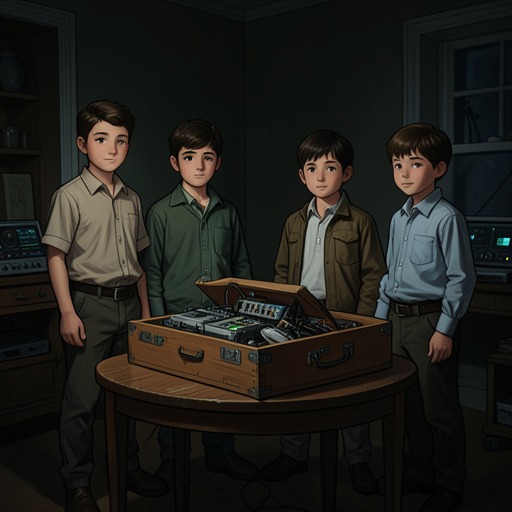
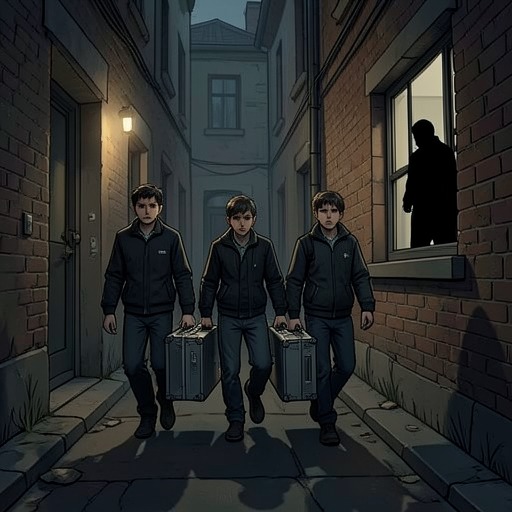
Gino’s friendship with Lukas is tested when Sanchez reveals a key from their school and proposes breaking in at night to take computers. Julius immediately supports the plan, but Lukas objects, warning Gino to consider what his father might do if the police brought him home. Gino reacts with sudden fury: he throws his lighter at a cabinet and insists that Lukas never speak about his father again. The threat of being beaten, he says, is already part of his life; joining the theft would at least give him a chance to have money and stop wearing shabby clothes. His voice breaks and he trembles as he commits himself to the scheme.
The outburst makes Gino’s decision legible as more than simple recklessness. He does not deny the danger of being caught; instead, he rejects the idea that avoiding trouble can protect him from violence at home. When Julius says he will help Gino even if Lukas refuses, Gino does not answer, but paces around the small room. The scene binds the friends through a choice that also exposes their different positions: Lukas sees the theft as an avoidable risk, while Gino sees poverty and his father’s violence as dangers already pressing on him.
Violence at Home and the Flight
Gino’s responses to danger are not consistently aggressive. During the confrontation with Djamel’s group, he walks beside Lukas with his head lowered and admits that he wants to get away. When the group later closes in at the park, Gino is there as Lukas freezes and drops the telescopic baton; after Cem attacks Djamel and the crowd surges into a brawl, Gino grabs Lukas by the shoulder, his own expression panicked. The scene places Gino among friends caught in escalating street violence, but does not present him as its instigator.
The violence in Gino’s home, by contrast, is described as an ongoing condition from which he sees no easy exit. In Julius’s later account, Henry beats Gino and Giovanna in front of him, drinks heavily, and takes the 200 euros Gino had received from the computer sale. Gino has told Julius that he wants to flee with his mother and Toni, but that Henry will not let them leave and keeps them confined. Hearing his mother being beaten while unable to help leaves Gino feeling powerless; Julius says he urged Gino to strike Henry with a bottle so the family could escape while Henry was unconscious. Gino had wanted to act but struggled to overcome his hesitation. Julius also says he obtained Tilidin for him, making his intervention part of the chain of events rather than a response after the fact.
The consequences arrive as a frantic call from Giovanna. She tells Julius that Gino has run away and that Henry is lying in blood on the floor; she does not know whether he is alive, and has called both the police and an ambulance. Julius explains that Gino struck his father on the head with a glass bottle and kicked him while he was down. The bottle also left Gino’s hand badly cut. Lukas rejects the report at first because the attack seems incompatible with the Gino he knows, but Julius confirms it and admits that he advised Gino to do it and supplied the drug. His confession shifts the friends’ understanding of the assault: it was connected to Gino’s desperate wish to protect his mother and brother, yet Julius’s attempt to help had helped propel him into a potentially lethal confrontation.
The flight ends, for the moment, not in safety but in uncertainty. Someone finds Gino unconscious at a bus stop on Fritz-Erler-Allee and calls emergency services; he is taken to Klinikum Neukölln, where his mother is on her way to him. Julius does not know whether Gino will survive, only that the hospital has notified Giovanna. Gino’s arc thus turns on the distance between wanting to escape violence and being driven to answer it with violence: the family’s immediate crisis brings him to hospital, while the friends left behind have no assurance of what will happen next.
Narrative Role and Significance
Gino’s choices expose how little distance there is between the dangers the boys fear and the risks they take to resist them. When Lukas cautions him against joining the theft, he points to Henry’s likely response if the police bring Gino home; Gino answers that a beating is already something he expects. Later, when he wants to get his mother and Toni out of the house, the plan Julius describes is not to seek outside protection but to incapacitate Henry long enough for them to escape. The movement from anticipated punishment to a bottle attack is therefore rooted in Gino’s sense that ordinary routes to safety are unavailable, even as the assault brings fresh danger to the whole family.
His story also complicates the friends’ idea of loyalty. Julius’s intervention comes from hearing about the violence and helplessness Gino experiences at home, but his advice and the Tilidin he obtains help turn a desperate wish to protect his family into an actual confrontation. Gino’s cut hand, Henry’s bloodied collapse, and the uncertainty surrounding Gino’s own hospitalization leave the intention and the consequences painfully entangled: an act meant to create a chance to flee has instead scattered the family and friends into a search for what happened next.